
Liver fat content measurement (non-invasive)
As part of the liver examination, we offer our patients the option of a non-invasive, pain-free assessment of liver fat content. In many cases, a liver puncture can thus be dispensed with.
By integrating the two non-invasive methods for assessing the stiffness of the liver tissue, namely RTE and SWM, it is possible to assess the chronological progression of liver inflammation and fibrosis with greater accuracy. A combined simultaneous estimation of the degree of steatosis (ATT index) makes Combi-Elasto a comprehensive tool for the differential diagnosis of liver diseases.
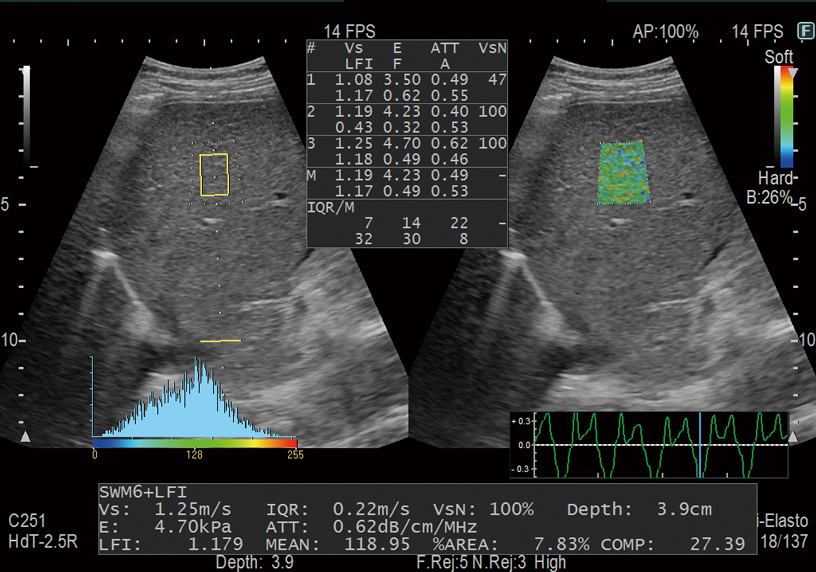
Measurement of liver fat content using the ATT index.
As part of the liver examination, we offer our patients the option of a non-invasive, pain-free assessment of liver fat content. In many cases, a liver puncture can thus be dispensed with.
By integrating the two non-invasive methods for assessing the stiffness of the liver tissue, namely RTE and SWM, it is possible to assess the chronological progression of liver inflammation and fibrosis with greater accuracy. A combined simultaneous estimation of the degree of steatosis (ATT index) makes Combi-Elasto a comprehensive tool for the differential diagnosis of liver diseases.
FAQ questions: Colorectal cancer screening and bowel screening.
Who carries out the screening?
Colonoscopy can be carried out on an outpatient basis in a gastrointestinal practice in almost all cases. A colonoscopy may only be performed by doctors who have completed special training for this examination. To ensure good quality, gastroenterologists must prove that they have performed a specified minimum number of colonoscopies per year. There are also special hygiene regulations and quality standards for practices and clinics that carry out colonoscopies, compliance with which is monitored.
What happens if polyps are detected?
Polyps are found in around 50% of patients during a colonoscopy. If they are small and inconspicuous, a follow-up examination after 10 years is usually sufficient. However, larger or more conspicuous polyps require earlier follow-up (usually after 3-5 years). We use various polyp removal procedures, such as cold snare ablation or underwater EMR, to safely remove the polyps.
Eating before the colonoscopy?
Patients should not eat any foods containing grains for about three days before the examination. This also includes fruits containing grains, such as berries or kiwis. 24 hours before the examination, care should be taken not to eat any foods that are difficult to digest or cause flatulence. On the day before the colonoscopy, patients may eat an easily digestible breakfast, after which they should avoid solid food. Drinking plenty of fluids in the form of water, tea or broth helps to flush the bowel. In the afternoon or evening and in the morning immediately before the examination, the patient takes a laxative to completely empty the bowel. The laxative is taken as a liquid. If a patient has a sluggish bowel, it is important that a change in diet is started earlier.