
Functional diagnostics of achalasia and motility disorders
At Vivomed, we want to ensure that you receive the best possible care for your gastrointestinal health. Esophageal manometry is an advanced examination method that helps us to understand the muscle function of your esophagus in detail. This examination helps to analyze problems such as difficulty swallowing, reflux, pain or other gastrointestinal complaints in more detail.
What is oesophageal manometry?
Oesophageal manometry is a diagnostic procedure that measures the function of the muscles in the oesophagus. Tiny pressure sensors are used to record the contractions and movements of the muscles.
What can patients expect during oesophageal manometry?
During the examination, a thin probe is inserted into the esophagus to measure muscle contractions. The examination usually takes about 30 to 60 minutes and is painless. You can breathe normally during the examination and must relax so that accurate measurements can be taken.
What is the procedure for oesophageal manometry?
- Preparation: You should not eat or drink anything for several hours before the examination to ensure an empty oesophagus.
- Procedure: A thin, flexible catheter is inserted into the oesophagus through the nose. While you swallow, the catheter measures the muscle contractions and pressure conditions along the esophagus.
- Data analysis: The recorded data is analyzed to evaluate the function of the esophageal muscles.
- Discussion of the results: After the examination, we will discuss the results with you and develop an individualized treatment plan.
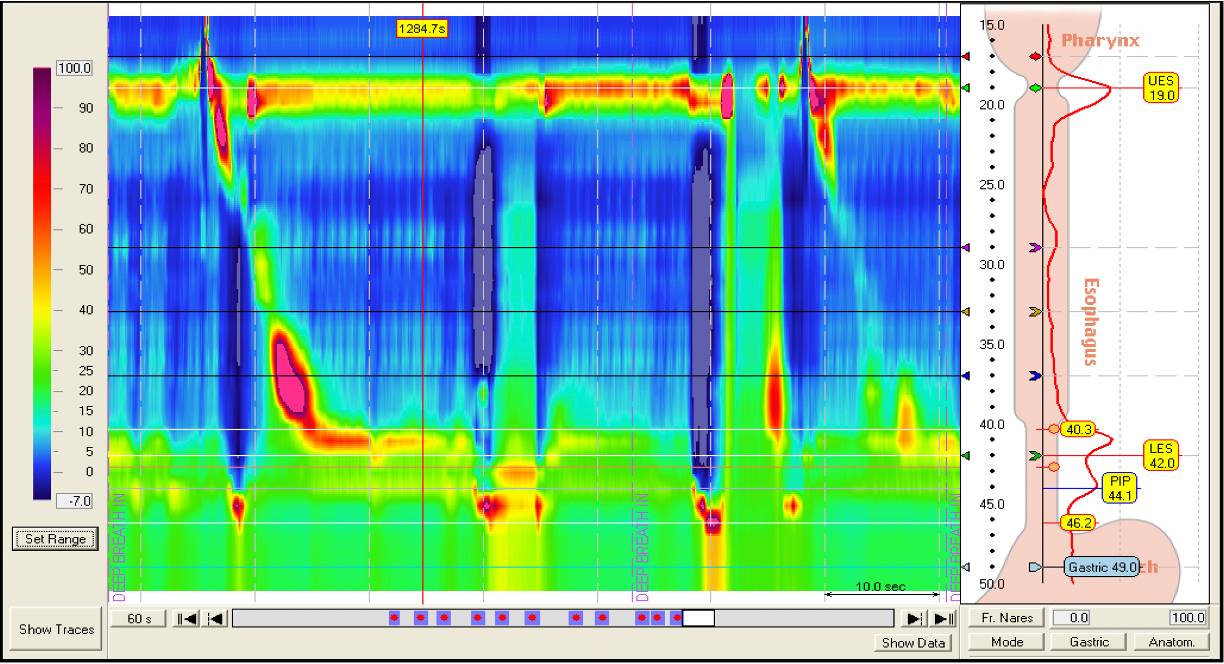
Why is manometry important?
Manometry is crucial to identify dysfunctions in the esophagus that are often difficult to detect. It enables a precise diagnosis of diseases such as
- Achalasia
- Diffuse esophageal spasms: irregular and coordinated contractions of the esophageal muscles.
- Gastroesophageal reflux disease (GERD): Reflux of stomach acid into the oesophagus, leading to heartburn and other symptoms.
- Dysphagia: Difficulty swallowing due to dysfunction of the esophageal muscles.
By accurately measuring muscle activity, we can make precise diagnoses and specific treatment recommendations.
Advantages of oesophageal manometry:
- Precise measurement of muscle activity in the gastrointestinal tract
- Diagnosis of swallowing problems, reflux and achalasia
- Minimally invasive: The procedure is minimally invasive and generally well tolerated.
- Fast results: The examination usually takes less than 30 minutes and provides immediately usable data.
Conclusion
Oesophageal manometry is an essential diagnostic procedure for investigating functional disorders of the oesophagus. Precise measurements allow us to develop targeted treatments that significantly improve your quality of life.
Visit our practice and benefit from state-of-the-art diagnostics and individual care. We look forward to helping you: Get in touch with us.
Why is manometry important?
Manometry is crucial to identify dysfunctions in the esophagus that are often difficult to detect. It enables a precise diagnosis of diseases such as
- Achalasia
- Diffuse esophageal spasms: irregular and coordinated contractions of the esophageal muscles.
- Gastroesophageal reflux disease (GERD): Reflux of stomach acid into the oesophagus, leading to heartburn and other symptoms.
- Dysphagia: Difficulty swallowing due to dysfunction of the esophageal muscles.
By accurately measuring muscle activity, we can make precise diagnoses and specific treatment recommendations.
Advantages of oesophageal manometry:
- Precise measurement of muscle activity in the gastrointestinal tract
- Diagnosis of swallowing problems, reflux and achalasia
- Minimally invasive: The procedure is minimally invasive and generally well tolerated.
- Fast results: The examination usually takes less than 30 minutes and provides immediately usable data.
Conclusion
Oesophageal manometry is an essential diagnostic procedure for investigating functional disorders of the oesophagus. Precise measurements allow us to develop targeted treatments that significantly improve your quality of life.
Visit our practice and benefit from state-of-the-art diagnostics and individual care. We look forward to helping you: Get in touch with us.
FAQ questions: Colorectal cancer screening and bowel screening.
Was ist gastroenterologische Funktionsdiagnostik?
Die gastroenterologische Funktionsdiagnostik untersucht die Beweglichkeit, Druckverhältnisse und weitere Funktionen des Verdauungstrakts. Bei Vivomed gehören dazu Refluxmessungen, die hochauflösende Ösophagusmanometrie sowie die anorektale Manometrie zur Untersuchung von Enddarm und Beckenboden.
Wann brauche ich eine Funktionsuntersuchung des Verdauungstrakts?
Eine Funktionsuntersuchung kann sinnvoll sein, wenn Beschwerden wie Sodbrennen, Schluckstörungen, chronische Verstopfung oder Stuhlinkontinenz bestehen und eine genauere Abklärung der zugrunde liegenden Funktionsstörung erforderlich ist.
Kann eine Funktionsstörung trotz normaler Magen- oder Darmspiegelung bestehen?
Ja. Eine Magen- oder Darmspiegelung untersucht vor allem die Schleimhaut und anatomische Veränderungen. Störungen der Beweglichkeit, Druckregulation oder Schliessmuskelfunktion können dabei unentdeckt bleiben und zusätzliche Funktionstests erforderlich machen.
Was ist der Unterschied zwischen pH-Metrie und Impedanz-pH-Metrie?
Die pH-Metrie misst die Säurebelastung der Speiseröhre. Eine kombinierte Impedanz-pH-Metrie kann zusätzlich Refluxereignisse unabhängig vom Säuregehalt erfassen und einen zeitlichen Zusammenhang zwischen Reflux und Beschwerden untersuchen.
Was ist der Unterschied zwischen Bravo-Kapsel und 24-Stunden-Impedanz-pH-Metrie?
Die Bravo-Kapsel misst die Säurebelastung über mehrere Tage drahtlos und ohne transnasalen Katheter während der Aufzeichnung. Die Impedanz-pH-Metrie verwendet einen dünnen Katheter und erfasst zusätzlich schwach saure und nichtsaure Refluxereignisse.
Wann wird eine Refluxmessung ohne Protonenpumpenhemmer durchgeführt?
Wenn eine Refluxkrankheit noch nicht objektiv nachgewiesen wurde, erfolgt die Refluxmessung häufig nach einer ärztlich angeordneten Pause säurehemmender Medikamente. Bei bereits gesicherter Refluxkrankheit und weiterhin bestehenden Beschwerden kann hingegen eine Messung unter Behandlung sinnvoll sein. Medikamente dürfen nicht eigenständig abgesetzt werden.
Was ist eine Ösophagusmanometrie?
Die Ösophagusmanometrie misst die Druckverhältnisse und Bewegungsabläufe der Speiseröhre. Sie dient insbesondere zur Abklärung von Schluckstörungen, Achalasie und weiteren Motilitätsstörungen.
Kann die Ösophagusmanometrie eine Achalasie erkennen?
Ja. Die hochauflösende Ösophagusmanometrie ist eine zentrale Untersuchung zur Diagnose und Klassifikation der Achalasie. Die Ergebnisse werden nach der Chicago-Klassifikation Version 4.0 beurteilt und bei Bedarf durch weitere Untersuchungen ergänzt.
Warum ist eine Ösophagusmanometrie vor einer Refluxoperation wichtig?
<p>Die Manometrie kann relevante Bewegungsstörungen der Speiseröhre erkennen, die für die Auswahl und Planung einer Antirefluxbehandlung wichtig sind. Für den objektiven Nachweis der Refluxkrankheit kann zusätzlich eine pH-Metrie oder Impedanz-pH-Metrie erforderlich sein.</p>
Was ist eine anorektale Manometrie?
Die anorektale Manometrie ist eine Druckmessung des Enddarms und des Analkanals. Sie untersucht unter anderem den Ruhedruck, Kneifdruck, die Koordination beim Pressen und die rektale Sensibilität.
Wann ist eine anorektale Manometrie bei Verstopfung sinnvoll?
Sie kann sinnvoll sein, wenn eine chronische Verstopfung mit erschwerter Stuhlentleerung, starkem Pressen oder dem Gefühl einer unvollständigen Entleerung verbunden ist. Damit lassen sich Hinweise auf eine gestörte Koordination des Beckenbodens erkennen.
Kann eine anorektale Manometrie bei Stuhlinkontinenz helfen?
Ja. Sie liefert Informationen über die Funktion des analen Schliessmuskels, die rektale Sensibilität und weitere Faktoren, die bei einer Stuhlinkontinenz eine Rolle spielen können. Je nach Befund sind zusätzliche Untersuchungen sinnvoll.
Was ist ein Ballonexpulsionstest?
Beim Ballonexpulsionstest wird untersucht, ob ein kleiner, im Enddarm platzierter Ballon unter standardisierten Bedingungen entleert werden kann. Der Test ergänzt die anorektale Manometrie insbesondere bei Verdacht auf eine Defäkationsstörung.
Sind gastroenterologische Funktionsuntersuchungen schmerzhaft?
Die meisten Untersuchungen werden ohne Sedierung durchgeführt und sind in der Regel gut verträglich. Das Einführen einer Sonde über die Nase oder in den Enddarm kann kurzzeitig unangenehm sein. Bei der Bravo-Kapsel-pH-Metrie erfolgt die Platzierung endoskopisch.
Muss ich für eine Funktionsuntersuchung nüchtern sein?
Die Vorbereitung hängt vom Verfahren ab. Bei Ösophagusmanometrie und endoskopischer Bravo-Kapselplatzierung ist normalerweise eine Nüchternphase erforderlich. Vor der anorektalen Manometrie wird gegebenenfalls ein kleiner Einlauf durchgeführt. Sie erhalten individuelle Anweisungen.
Wie lange dauert die gastroenterologische Funktionsdiagnostik?
Eine Ösophagusmanometrie oder anorektale Manometrie dauert häufig ungefähr 20 bis 45 Minuten. Bei einer Refluxmessung erfolgt die Aufzeichnung hingegen über ungefähr 24 Stunden beziehungsweise bei einer drahtlosen Kapsel-pH-Metrie häufig über 48 bis 96 Stunden.