
An effective neuromodulation treatment for incontinence and chronic pain
What is percutaneous tibial nerve stimulation (PTNS)?
Percutaneous tibial nerve stimulation (PTNS) is an innovative neuromodulation treatment in which the tibial nerve, an important nerve on the shin, is stimulated in a targeted manner. Neuromodulation refers to the targeted influencing of nerve functions in order to positively change the function of organs or bodily processes. In the case of PTNS, this method can effectively improve the functioning of the bladder and urinary and fecal sphincter, making it a valuable option in the treatment of incontinence and other urological conditions.
Areas of application for PTNS
PTNS is primarily used in the following areas:
- overactive bladder (urge incontinence): The most common use of PTNS is to treat an overactive bladder that leads to involuntary leakage of urine. Studies show that up to 60% of patients experience a significant calming of the bladder with PTNS. This treatment option is particularly suitable for patients who cannot tolerate medication for urge incontinence (such as anticholinergics) or for whom this medication is not effective. It is also a sensible alternative if Botox therapy is not possible or not desired.
- Fecal incontinence: Neuromodulation of the tibial nerve can also be effective for urge incontinence, i.e. involuntary loss of stool. This application is particularly relevant for patients suffering from both forms of incontinence.
- Chronic pelvic pain syndrome (PPS): Another area of application for PTNS is the treatment of chronic pelvic pain syndrome, also known as chronic prostatitis. By stimulating the tibial nerve, the pelvic floor can be calmed, which leads to relief from the cramp-like pain.
How PTNS works
PTNS is performed by targeted stimulation of the tibial nerve using a very fine acupuncture needle. This needle transmits weak electrical impulses to the tibial nerve, which triggers an increased nerve stimulus. This stimulus is processed in the spinal cord in the so-called sacral micturition center, which also controls the nerves responsible for controlling the bladder and sphincter.
The PTNS therapy procedure
PTNS is a minimally invasive procedure that is performed on an outpatient basis. A full course of therapy usually consists of 12 sessions spread over 12 weeks, with one session per week lasting around 30 minutes. Many patients notice an improvement in their symptoms after the fourth to sixth session. If the therapy is successful, maintenance therapy is recommended every 3 weeks.
Side effects and risks of PTNS
PTNS is a very safe and well-tolerated treatment method with minimal side effects. The most common side effects include slight redness and short-term pain at the point where the acupuncture needle is inserted. In rare cases, inflammation may occur at the puncture site. Some patients report a feeling of pressure in the stomach area during the treatment, but this disappears immediately after the end of the session. PTNS is also not associated with long-term risks such as stomach ulcers.
Scientific acceptance
Although PTNS is not yet widely used in Switzerland, it has passed internationally recognized scientific tests and is anchored in several urological guidelines, among others. These include the guidelines of the European Association of Urology (EAU) and the recommendations of the British NICE guidelines.
Conclusion
Percutaneous tibial nerve stimulation (PTNS) offers an effective, minimally invasive treatment option for patients with involuntary loss of urine and stool and chronic pelvic floor pain. Thanks to its good tolerability and proven efficacy, PTNS is a valuable alternative to drug or surgical treatments, especially for patients who do not respond to other therapies.
What is percutaneous tibial nerve stimulation (PTNS)?
Percutaneous tibial nerve stimulation (PTNS) is an innovative neuromodulation treatment in which the tibial nerve, an important nerve on the shin, is stimulated in a targeted manner. Neuromodulation refers to the targeted influencing of nerve functions in order to positively change the function of organs or bodily processes. In the case of PTNS, this method can effectively improve the functioning of the bladder and urinary and fecal sphincter, making it a valuable option in the treatment of incontinence and other urological conditions.
Areas of application for PTNS
PTNS is primarily used in the following areas:
- overactive bladder (urge incontinence): The most common use of PTNS is to treat an overactive bladder that leads to involuntary leakage of urine. Studies show that up to 60% of patients experience a significant calming of the bladder with PTNS. This treatment option is particularly suitable for patients who cannot tolerate medication for urge incontinence (such as anticholinergics) or for whom this medication is not effective. It is also a sensible alternative if Botox therapy is not possible or not desired.
- Fecal incontinence: Neuromodulation of the tibial nerve can also be effective for urge incontinence, i.e. involuntary loss of stool. This application is particularly relevant for patients suffering from both forms of incontinence.
- Chronic pelvic pain syndrome (PPS): Another area of application for PTNS is the treatment of chronic pelvic pain syndrome, also known as chronic prostatitis. By stimulating the tibial nerve, the pelvic floor can be calmed, which leads to relief from the cramp-like pain.
How PTNS works
PTNS is performed by targeted stimulation of the tibial nerve using a very fine acupuncture needle. This needle transmits weak electrical impulses to the tibial nerve, which triggers an increased nerve stimulus. This stimulus is processed in the spinal cord in the so-called sacral micturition center, which also controls the nerves responsible for controlling the bladder and sphincter.
The PTNS therapy procedure
PTNS is a minimally invasive procedure that is performed on an outpatient basis. A full course of therapy usually consists of 12 sessions spread over 12 weeks, with one session per week lasting around 30 minutes. Many patients notice an improvement in their symptoms after the fourth to sixth session. If the therapy is successful, maintenance therapy is recommended every 3 weeks.
Side effects and risks of PTNS
PTNS is a very safe and well-tolerated treatment method with minimal side effects. The most common side effects include slight redness and short-term pain at the point where the acupuncture needle is inserted. In rare cases, inflammation may occur at the puncture site. Some patients report a feeling of pressure in the stomach area during the treatment, but this disappears immediately after the end of the session. PTNS is also not associated with long-term risks such as stomach ulcers.
Scientific acceptance
Although PTNS is not yet widely used in Switzerland, it has passed internationally recognized scientific tests and is anchored in several urological guidelines, among others. These include the guidelines of the European Association of Urology (EAU) and the recommendations of the British NICE guidelines.
Conclusion
Percutaneous tibial nerve stimulation (PTNS) offers an effective, minimally invasive treatment option for patients with involuntary loss of urine and stool and chronic pelvic floor pain. Thanks to its good tolerability and proven efficacy, PTNS is a valuable alternative to drug or surgical treatments, especially for patients who do not respond to other therapies.
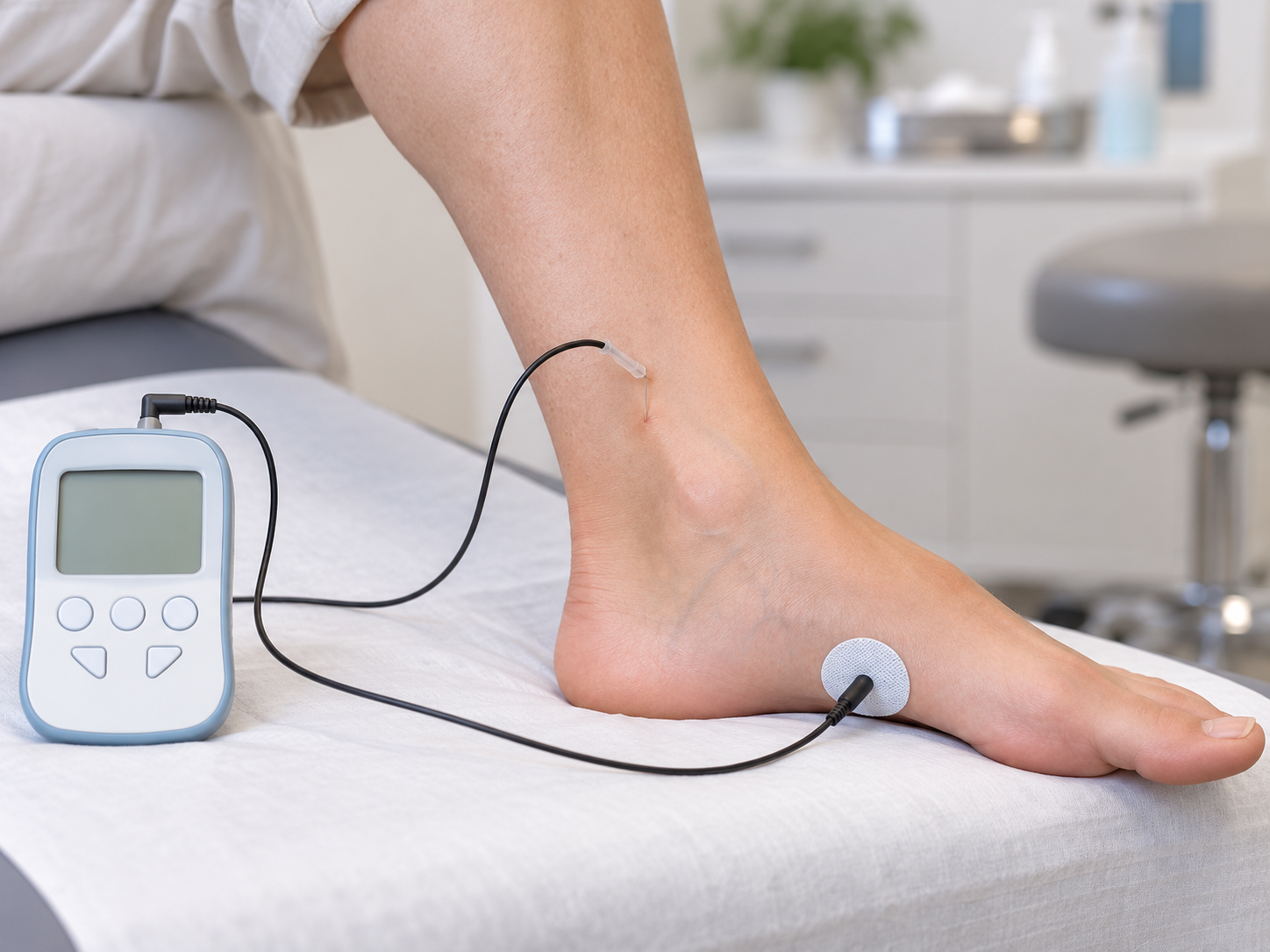
PTNS-Behandlung mit Nadelelektrode am Innenknöchel zur Therapie von Stuhlinkontinenz
Für wen ist eine PTNS-Behandlung geeignet?
Die perkutane Tibialnervenstimulation kann bei ausgewählten Patientinnen und Patienten mit Stuhlinkontinenz als ergänzende Therapie erwogen werden.
Mögliche Voraussetzungen
- Wiederkehrende, belastende Stuhlinkontinenz
- Unzureichendes Ansprechen auf Stuhlregulation, Ernährungsanpassung oder Beckenbodentraining
- Fehlende oder begrenzte Eignung anderer Verfahren
- Möglichkeit zur regelmässigen Teilnahme an den Behandlungssitzungen
- Individuelle Nutzen-Risiko-Abwägung nach gastroenterologischer Abklärung
Wann ist eine andere Behandlung wichtiger?
Liegt beispielsweise ein relevanter Schliessmuskeldefekt, ein Rektumprolaps, eine Überlaufinkontinenz bei ausgeprägter Obstipation oder eine aktive entzündliche Darmerkrankung vor, kann eine andere Behandlung vorrangig sein.
Auch chronischer Durchfall muss zunächst nach seiner Ursache abgeklärt und möglichst gezielt behandelt werden.
PTNS bei überaktiver Blase
Die PTNS wird auch in der Urologie zur Behandlung einer überaktiven Blase eingesetzt.
Bei kombinierter Harn- und Stuhlinkontinenz kann eine interdisziplinäre Beurteilung sinnvoll sein.
Die therapeutischen Empfehlungen unterscheiden sich jedoch je nach Erkrankung und dürfen nicht unmittelbar übertragen werden.
Welche Untersuchungen sind vor einer PTNS sinnvoll?
Die Behandlung von Stuhlinkontinenz beginnt mit einer sorgfältigen fachärztlichen Abklärung.
Je nach Beschwerden prüfen wir, ob die Ursache vor allem in der Stuhlkonsistenz, einer Schliessmuskelschwäche, einer Sensibilitätsstörung oder einer gestörten Beckenbodenkoordination liegt.
1. Anorektale Manometrie (3D-HR-ARM)
Mit der hochauflösenden anorektalen Manometrie lassen sich Druck, Schliessmuskelfunktion und relevante Funktionsabläufe im Analkanal und Enddarm untersuchen.
Diese Untersuchung kann helfen, unterschiedliche Formen der Stuhlinkontinenz voneinander abzugrenzen.
Mehr zur anorektalen Manometrie bei Vivomed
2. Endoanale Endosonographie
Mit der Endosonographie können strukturelle Veränderungen der Schliessmuskulatur untersucht werden.
Besonders relevant ist dies bei möglichen Verletzungen nach Geburten oder analen Operationen.
Endosonographie und Beckenbodendiagnostik bei Vivomed
3. Stuhl- und Beschwerdetagebuch
Die Dokumentation von Stuhlgewohnheiten, Inkontinenzereignissen, Stuhldrang und Stuhlkonsistenz unterstützt die individuelle Beurteilung.
Bei Bedarf setzen wir standardisierte Inkontinenz-Scores ein.
4. Neurogastroenterologische Sprechstunde
Bei komplexen Funktionsstörungen des Enddarms und Beckenbodens erfolgt eine weiterführende neurogastroenterologische Beurteilung.
Sprechstunde für Neurogastroenterologie und Motilitätsstörungen
Wie läuft eine PTNS-Behandlung ab?
Die perkutane Tibialnervenstimulation erfolgt ambulant und benötigt in der Regel keine Sedierung oder Narkose.
1. Platzierung der Elektrode
Eine sehr feine Nadelelektrode wird im Bereich des Innenknöchels platziert.
Zusätzlich wird eine Oberflächenelektrode am Fuss angebracht.
2. Elektrische Stimulation
Über ein Stimulationsgerät werden schwache, kontrollierte elektrische Impulse abgegeben.
Ein leichtes Kribbeln im Fuss oder eine Bewegung der Zehen kann anzeigen, dass die Stimulation den vorgesehenen Nervenbereich erreicht.
3. Behandlungsdauer
Eine Sitzung dauert üblicherweise 30 Minuten.
Ein häufig verwendetes Initialschema umfasst 12 Sitzungen über etwa 12 Wochen, meist einmal wöchentlich.
4. Auswertung der Behandlung
Nach Abschluss der Initialbehandlung werden die Beschwerden und der Verlauf erneut beurteilt.
Hierzu können ein Stuhltagebuch, die Anzahl der Inkontinenzereignisse und standardisierte Fragebögen herangezogen werden.
5. Erhaltungstherapie
Wenn die PTNS zu einer relevanten Verbesserung führt, können wiederholte Auffrischungssitzungen erwogen werden.
Die Intervalle sind nicht einheitlich festgelegt und richten sich nach dem individuellen Verlauf.
Wie wirksam ist PTNS bei Stuhlinkontinenz?
Die Wirkung der perkutanen Tibialnervenstimulation bei Stuhlinkontinenz wurde in mehreren klinischen Studien untersucht.
Ein Teil der Behandelten berichtet über weniger Inkontinenzereignisse oder eine bessere Stuhlkontrolle.
Was zeigen wissenschaftliche Studien?
Eine 2024 veröffentlichte Metaanalyse randomisierter Studien fand unter PTNS im Vergleich zur Scheinstimulation im Durchschnitt eine Verringerung der wöchentlichen Stuhlinkontinenzepisoden.
Die Ergebnisse waren jedoch nicht für alle Endpunkte eindeutig.
Insbesondere zeigten sich keine konsistenten Verbesserungen bei standardisierten Inkontinenz-Scores und der Lebensqualität.
Wie bewerten Leitlinien die PTNS?
Internationale Empfehlungen weisen darauf hin, dass die Wirksamkeit insbesondere bei Stuhlinkontinenz noch nicht ausreichend gesichert ist.
Die PTNS sollte daher nach sorgfältiger Diagnostik und individueller Nutzen-Risiko-Abwägung eingesetzt werden.
Wann tritt eine Wirkung ein?
Eine mögliche Besserung kann im Verlauf der Behandlung auftreten.
Ein zuverlässiges Ansprechen nach einer bestimmten Anzahl von Sitzungen kann jedoch nicht garantiert werden.
PTNS kann Beschwerden lindern, ist aber keine garantierte Heilung der Stuhlinkontinenz.
about the author: Dr. Stefan Schlosser is a specialist in gastroenterology and general internal medicine and holds a master's degree in health economics. With over 20 years of professional experience, he has a wealth of clinical and scientific experience. He specializes in interventional minimally invasive endoscopy, functional diagnostics and endobariology. Dr. Schlosser is a course leader for the SGUM in ultrasound training for young doctors and is a member of the Swiss, European and American Society of Gastroenterology (SGG, ESGE, ASGE). He works in an SIWF-recognized outpatient training center in Bern.
Welche Alternativen zur PTNS gibt es?
Die Behandlung der Stuhlinkontinenz richtet sich nach der zugrunde liegenden Ursache.
Stuhlregulation
Eine gezielte Anpassung der Stuhlkonsistenz kann bereits zu einer deutlichen Verbesserung der Kontinenz führen.
Hierzu kommen je nach Situation Ballaststoffe, Antidiarrhoika oder die Behandlung einer Obstipation infrage.
Beckenbodentraining und Biofeedback
Ein spezialisiertes Beckenbodentraining mit Biofeedback kann die Koordination und Kontrolle der Beckenboden- und Schliessmuskulatur unterstützen.
Sakrale Neuromodulation
Die sakrale Neuromodulation ist ein anderes, stärker invasives Verfahren mit implantiertem Stimulationssystem.
Sie ist bei ausgewählten Patientinnen und Patienten mit Stuhlinkontinenz eine etablierte Behandlungsoption.
Operative Behandlung
Bei bestimmten anatomischen Schliessmuskeldefekten oder anderen strukturellen Ursachen kann eine chirurgische Behandlung sinnvoll sein.
Welche Therapie geeignet ist, entscheiden wir anhand der klinischen Situation und der Ergebnisse der Funktionsdiagnostik.
FAQ questions: Colorectal cancer screening and bowel screening.
Who carries out the screening?
Colonoscopy can be carried out on an outpatient basis in a gastrointestinal practice in almost all cases. A colonoscopy may only be performed by doctors who have completed special training for this examination. To ensure good quality, gastroenterologists must prove that they have performed a specified minimum number of colonoscopies per year. There are also special hygiene regulations and quality standards for practices and clinics that carry out colonoscopies, compliance with which is monitored.
Who carries out the screening?
Colonoscopy can be carried out on an outpatient basis in a gastrointestinal practice in almost all cases. A colonoscopy may only be performed by doctors who have completed special training for this examination. To ensure good quality, gastroenterologists must prove that they have performed a specified minimum number of colonoscopies per year. There are also special hygiene regulations and quality standards for practices and clinics that carry out colonoscopies, compliance with which is monitored.
Who carries out the screening?
Colonoscopy can be carried out on an outpatient basis in a gastrointestinal practice in almost all cases. A colonoscopy may only be performed by doctors who have completed special training for this examination. To ensure good quality, gastroenterologists must prove that they have performed a specified minimum number of colonoscopies per year. There are also special hygiene regulations and quality standards for practices and clinics that carry out colonoscopies, compliance with which is monitored.
Who carries out the screening?
Colonoscopy can be carried out on an outpatient basis in a gastrointestinal practice in almost all cases. A colonoscopy may only be performed by doctors who have completed special training for this examination. To ensure good quality, gastroenterologists must prove that they have performed a specified minimum number of colonoscopies per year. There are also special hygiene regulations and quality standards for practices and clinics that carry out colonoscopies, compliance with which is monitored.
Who carries out the screening?
Colonoscopy can be carried out on an outpatient basis in a gastrointestinal practice in almost all cases. A colonoscopy may only be performed by doctors who have completed special training for this examination. To ensure good quality, gastroenterologists must prove that they have performed a specified minimum number of colonoscopies per year. There are also special hygiene regulations and quality standards for practices and clinics that carry out colonoscopies, compliance with which is monitored.
Who carries out the screening?
Colonoscopy can be carried out on an outpatient basis in a gastrointestinal practice in almost all cases. A colonoscopy may only be performed by doctors who have completed special training for this examination. To ensure good quality, gastroenterologists must prove that they have performed a specified minimum number of colonoscopies per year. There are also special hygiene regulations and quality standards for practices and clinics that carry out colonoscopies, compliance with which is monitored.
Kann man SIBO und IMO mit demselben Test nachweisen?
Zur Beurteilung einer methanassoziierten intestinalen Methanogen-Überwucherung (IMO) ist zusätzlich eine Methanmessung erforderlich. Ein reiner H₂-Test reicht dafür nicht aus.
Ist bei Reizdarm immer ein Atemtest notwendig?
Nein. Die Diagnose eines Reizdarmsyndroms erfordert nicht routinemässig einen Atemtest. Bei bestimmten Verdachtsdiagnosen kann die Untersuchung jedoch ergänzende Informationen liefern.
Muss ich bei einer Laktoseintoleranz vollständig auf Milchprodukte verzichten?
Meist nicht. Die verträgliche Laktosemenge ist individuell unterschiedlich. Viele Betroffene können kleine Mengen Laktose oder laktosefreie Milchprodukte problemlos konsumieren.
Welche Untersuchungen sind vor PTNS sinnvoll?
Je nach Beschwerdebild können eine anorektale Manometrie, Endosonographie und eine spezialisierte Beckenbodenuntersuchung sinnvoll sein.

PTNS und Behandlung von Stuhlinkontinenz bei Vivomed in Bern
Sie leiden unter unwillkürlichem Stuhlverlust, starkem Stuhldrang oder anderen Beckenbodenbeschwerden?
Bei Vivomed bieten wir eine spezialisierte gastroenterologische Abklärung mit hochauflösender anorektaler Manometrie und ergänzenden Untersuchungsverfahren an.
Auf dieser Grundlage besprechen wir geeignete konservative und neuromodulatorische Behandlungsoptionen.
Jetzt Beratungstermin vereinbaren
Vivomed – Gastroenterologie Bern
Waisenhausplatz 28
3011 Bern
Telefon: 031 333 32 36
E-Mail: vivomed@hin.ch
Über den medizinischen Autor
Dr. med. Stefan H. Schlosser, MBA, FEBGH
Facharzt FMH für Gastroenterologie und Allgemeine Innere Medizin
Dr. med. Stefan H. Schlosser ist Gastroenterologe und Leiter von Vivomed – Gastroenterologie Bern.
Zu seinen klinischen Schwerpunkten gehören die gastroenterologische Funktionsdiagnostik, Neurogastroenterologie, anorektale Manometrie und die Abklärung von Beckenboden- und Darmentleerungsstörungen.
Mehr über Dr. med. Stefan Schlosser
Medizinisch aktualisiert: Oktober 2026
Wissenschaftliche Grundlagen
- NICE. Percutaneous tibial nerve stimulation for faecal incontinence. HealthTech Guidance HTG263. NICE-Empfehlung
- Tahmasbi F et al. Effects of Posterior Tibial Nerve Stimulation on Fecal Incontinence: An Umbrella Review. Neuromodulation. 2024. Übersichtsarbeit
- Is percutaneous tibial nerve stimulation effective for fecal incontinence in adults compared with sham electrical stimulation? A meta-analysis. Techniques in Coloproctology. 2024. Randomisierte Evidenz
Die Informationen ersetzen keine individuelle ärztliche Untersuchung oder Therapieentscheidung.