
Modern endoscopic reflux treatment: treating heartburn without tablets.
Chronic reflux and heartburn can have a major impact on everyday life. If medication or lifestyle changes are not enough, innovative endoscopic treatments such as anti-reflux mucosectomy (ARMS) or anti-reflux band mucosectomy (ARBM) are available. This minimally invasive procedure offers an effective solution for patients with a hiatal hernia of up to 2 cm or caria insufficiency.
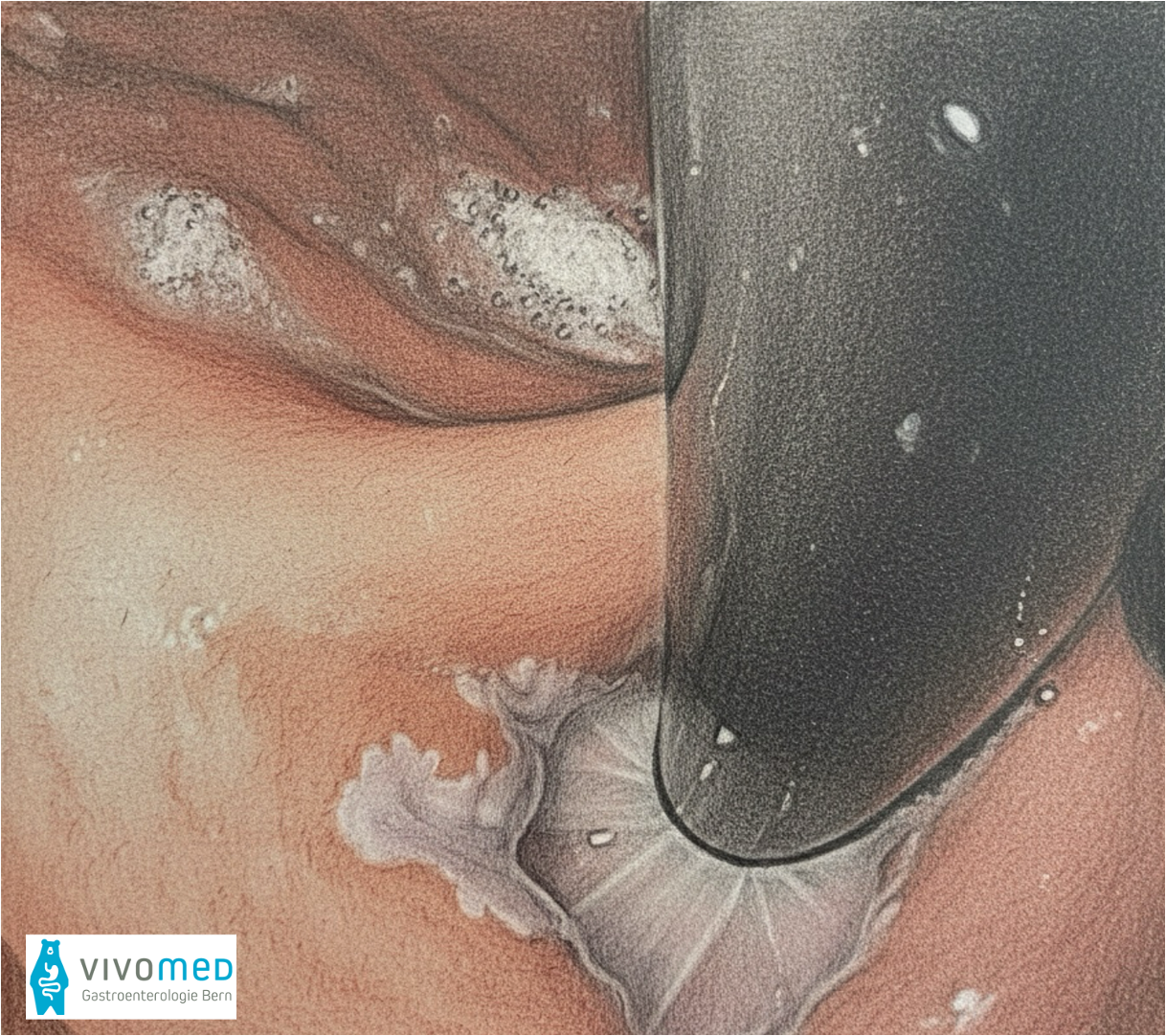
In this article you will learn how ARMS works, for whom the treatment is suitable and what benefits it offers.
What is an anti-reflux mucosectomy (ARMS)?
Anti-reflux mucosectomy is a modern, endoscopic procedure for the treatment of gastroesophageal reflux (GERD). The aim of the method is to improve the natural barrier function of the lower oesophageal sphincter by specifically removing parts of the mucosa in the stomach entrance.
This tissue removal tightens the area of the stomach entrance, which effectively reduces the reflux of stomach acid into the oesophagus.
Chronic reflux and heartburn can have a major impact on everyday life. If medication or lifestyle changes are not enough, innovative endoscopic treatments such as anti-reflux mucosectomy (ARMS) or anti-reflux band mucosectomy (ARBM) are available. This minimally invasive procedure offers an effective solution for patients with a hiatal hernia of up to 2 cm or caria insufficiency.
In this article you will learn how ARMS works, for whom the treatment is suitable and what benefits it offers.
What is an anti-reflux mucosectomy (ARMS)?
Anti-reflux mucosectomy is a modern, endoscopic procedure for the treatment of gastroesophageal reflux (GERD). The aim of the method is to improve the natural barrier function of the lower oesophageal sphincter by specifically removing parts of the mucosa in the stomach entrance.
This tissue removal tightens the area of the stomach entrance, which effectively reduces the reflux of stomach acid into the oesophagus.
Anti Reflux Mucosectomy (ARMS)

Chronic reflux and heartburn can have a major impact on everyday life. If medication or lifestyle changes are not enough, innovative endoscopic treatments such as anti-reflux mucosectomy (ARMS) or anti-reflux band mucosectomy (ARBM) are available. This minimally invasive procedure offers an effective solution for patients with a hiatal hernia of up to 2 cm or caria insufficiency.
In this article you will learn how ARMS works, for whom the treatment is suitable and what benefits it offers.
What is an anti-reflux mucosectomy (ARMS)?
Anti-reflux mucosectomy is a modern, endoscopic procedure for the treatment of gastroesophageal reflux (GERD). The aim of the method is to improve the natural barrier function of the lower oesophageal sphincter by specifically removing parts of the mucosa in the stomach entrance.
This tissue removal tightens the area of the stomach entrance, which effectively reduces the reflux of stomach acid into the oesophagus.
Your experts for the ARMS method in Bern
Our gastroenterology practice in Bern specializes in modern treatments for reflux and heartburn. Anti-reflux mucosectomy (ARMS) offers you a minimally invasive and effective solution for chronic reflux.
Makean appointment for a consultation and find out how we can help you treat your symptoms effectively.
How does anti-reflux mucosectomy work?
ARMS treatment is performed on an outpatient basis using an endoscope. The procedure usually takes less than an hour and patients can go home the same day.
Who is ARMS suitable for?
ARMS treatment can be recommended for patients who:
- Suffer from chronic reflux and do not respond adequately to medication such as proton pump inhibitors (PPI).
- Want to manage without medication in the long term.
- Do not want traditional surgery (e.g. fundoplication).
- Have mild to moderate forms of reflux disease.
- do not have a relevant hiatal hernia over 2 cm
Results and chances of success of ARMS?
Studies and experience reports show that anti-reflux mucosectomy significantly improves the quality of life for many patients. After the procedure, most report a significant reduction in heartburn and reflux.

Dr. Stefan Schlosser, gastroenterologist at Vivomed in Bern, explains: "The ARMS method is an excellent option for selected patients who are looking for a minimally invasive and effective solution to reflux. We combine modern technology with individually tailored aftercare to achieve optimal results."
Risks and aftercare for endoscopic reflux treatment?
As with any medical procedure, there are potential risks with the ARMS method, but these are minimal. Rare side effects include temporary difficulty swallowing or pain in the treatment area. Bleeding or injury to the wall layer does not usually occur. After the procedure, patients should switch to soft and easily digestible food for a few days to support healing. Acid inhibitors are necessary until healing is complete. Regular follow-up checks ensure that the treatment is successful.
When should you consider ARMS treatment?
The ARMS method is an effective alternative when:
- Medication is not enough.
- Cough persists despite stomach protectors
- Reflux impairs your quality of life.
- You are looking for a gentle, long-term solution.
With endoscopic anti-reflux treatment, reflux is treated effectively and gently for selected patients. Contact us and let us advise you individually!
about the author: Dr. Stefan Schlosser is a specialist in gastroenterology and general internal medicine and holds a master's degree in health economics. With over 20 years of professional experience, he has a wealth of clinical and scientific experience. He specializes in interventional minimally invasive endoscopy, functional diagnostics and endobariology. Dr. Schlosser is a course leader for the SGUM in ultrasound training for young doctors and is a member of the Swiss, European and American Society of Gastroenterology (SGG, ESGE, ASGE). He works in an SIWF-recognized outpatient training center in Bern.
Liquid Biopsy und etablierte Krebsfrüherkennung: Was ist der Unterschied?
Die Liquid Biopsy sollte nicht mit etablierten Untersuchungen zur Krebsfrüherkennung verwechselt werden.
Darmkrebsvorsorge
Die Vorsorgekoloskopie ermöglicht die direkte Beurteilung der Dickdarmschleimhaut und die Entfernung vieler Krebsvorstufen.
Sie kann durch einen CTC-Bluttest nicht ersetzt werden.
Mehr zu den endoskopischen Untersuchungen bei Vivomed
Abklärung auffälliger Befunde
Bei Verdacht auf eine gastrointestinale Tumorerkrankung kommen abhängig vom klinischen Bild Gastroskopie, Koloskopie, Endosonografie und gezielte Gewebeuntersuchungen infrage.
FAQ questions: Colorectal cancer screening and bowel screening.
Who carries out the screening?
Colonoscopy can be carried out on an outpatient basis in a gastrointestinal practice in almost all cases. A colonoscopy may only be performed by doctors who have completed special training for this examination. To ensure good quality, gastroenterologists must prove that they have performed a specified minimum number of colonoscopies per year. There are also special hygiene regulations and quality standards for practices and clinics that carry out colonoscopies, compliance with which is monitored.
Kann man SIBO und IMO mit demselben Test nachweisen?
Zur Beurteilung einer methanassoziierten intestinalen Methanogen-Überwucherung (IMO) ist zusätzlich eine Methanmessung erforderlich. Ein reiner H₂-Test reicht dafür nicht aus.

Beratung zur Liquid Biopsy bei Vivomed Bern
Sie haben Fragen zur Aussagekraft einer Liquid Biopsy oder möchten eine bestehende diagnostische Fragestellung besprechen?
Bei Vivomed beraten wir Sie zu geeigneten gastroenterologischen Untersuchungen und den Möglichkeiten ergänzender Diagnostik.
Vivomed – Gastroenterologie Bern
Waisenhausplatz 28
3011 Bern
Telefon: 031 333 32 36
E-Mail: vivomed@hin.ch
Kontakt und Terminvereinbarung
Über den medizinischen Autor
Dr. med. Stefan H. Schlosser, MBA, FEBGH
Facharzt FMH für Gastroenterologie und Allgemeine Innere Medizin
Dr. med. Stefan H. Schlosser ist Gastroenterologe und Leiter von Vivomed – Gastroenterologie Bern.
Seine klinischen Schwerpunkte umfassen die diagnostische und interventionelle Endoskopie, die Abklärung gastrointestinaler Erkrankungen und moderne minimalinvasive Untersuchungsverfahren.
Mehr über Dr. med. Stefan Schlosser erfahren
Medizinischer Stand: Oktober 2026
Wissenschaftliche Grundlagen
- National Cancer Institute. Cancer Screening Tests. Informationen zu Multikrebs-Früherkennungstests
- National Cancer Institute. Tumor Markers. Informationen zu Tumormarkern
- Pascual J et al. ESMO recommendations on the use of circulating tumour DNA assays. Annals of Oncology. 2022. ESMO-Empfehlungen
Informationen zur ctDNA-Diagnostik dürfen nicht ohne gesonderte Validierung auf CTC-Testverfahren übertragen werden.